
Although we have been a bit quiet again over the last two weeks, that definitely does not mean nothing has been happening behind the scenes — there is no summer lull for GCP.
First, the facts and figures: over the last two weeks, we diverted 263.2 lbs from landfill, bringing our total to 20,778.3 lbs diverted and 17.32 cubic yards of landfill space saved.
It has not all been straightforward. Two new obstacles have popped up. First, some neighborhood animals have discovered our drop-off bin, and there have been a few nocturnal food fights, which have been messy to clean up. Our solution has been to bring the drop-off bucket up to the house overnight, secure the lid firmly, and put it back out the next morning. Second, our garbage and recycling collection happens on Fridays, and the collection crew has been a little too enthusiastic in spotting things to take. We try to make sure all dropped-off scraps are carried up the hill before they arrive, but we may need to have a quick chat with them too.
Another big focus lately has been heat treating our finished compost. This is one of the most time-consuming and exhausting parts of the whole process and is causing a bottleneck. Right now, we heat treat by microwaving small batches, which is slow, and messy, and its inefficiency means we are growing a huge stockpile of untreated compost which would be so much better off being used in the community. We don't feel we can skip the heat treatment process though, as it would not be responsible to give away compost, or use it for fundraising unless we have done our best to make sure it is safe for distribution.
That means thinking not just about things like potential jumping worms, but also anything else that could cause problems in someone’s garden, including stray weed seeds or fruit and vegetable seeds that might survive and sprout later. Heat treatment is widely used because high enough temperatures can help reduce pests, seeds, and pathogens. UMass Amherst notes that temperatures above 104°F are lethal to jumping worms and their cocoons, and more broadly, sustained heat is important for killing weed seeds and reducing pathogens.
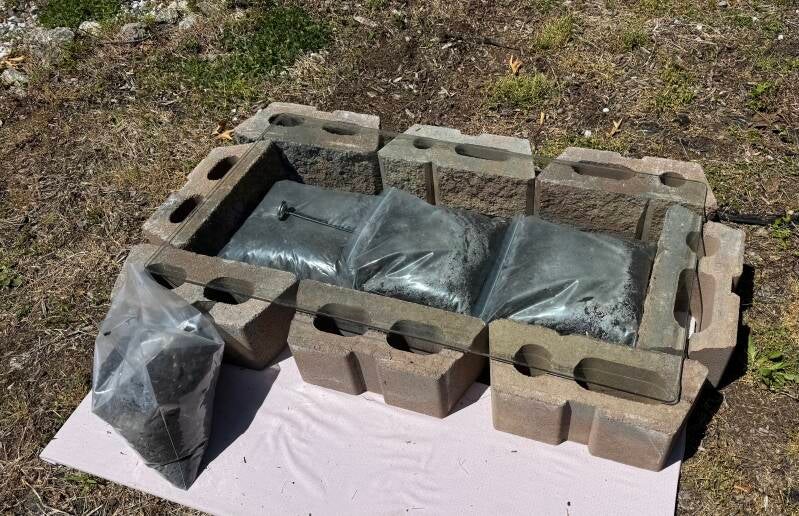
So lately we have been brainstorming cheap ways to heat-treat compost more efficiently. Then inspiration struck. We have a redundant piece of glass on the property, and it dawned on us that we might be able to build our very own solarization box using this glass.
So that is exactly what we did.
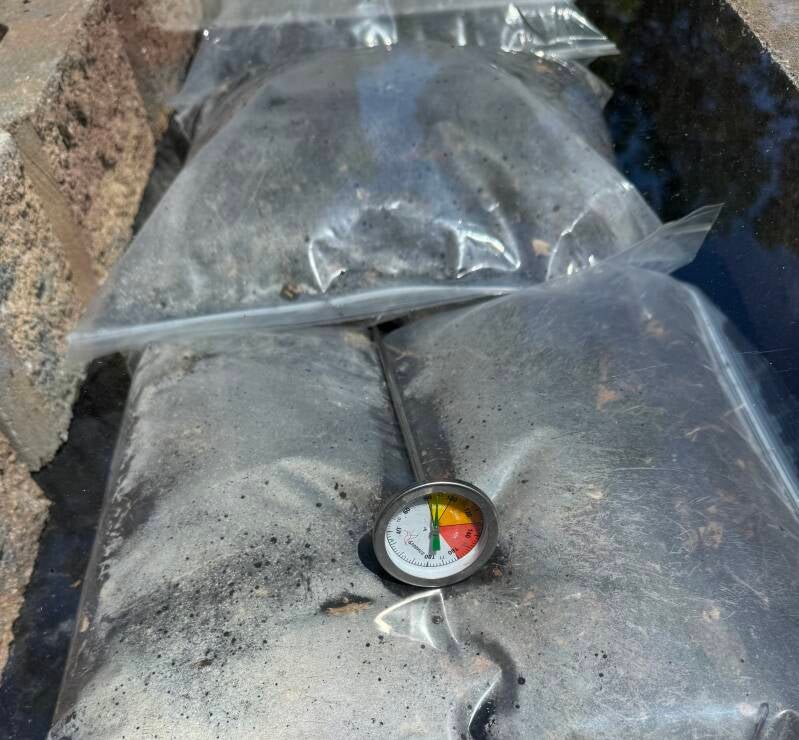
Our current prototype uses a dark base (black bin liner), bricks, the glass top, and sealed clear bags of compost. At the moment, it can hold 3 bags at a time, and we are monitoring the temperature in the middle bag to see how well the system works. UMass Amherst says solarization looks promising for managing jumping worms and their cocoons, but also notes that the method is still being refined and that details like covering, underlay, batch size, and duration all matter.
So far, our box is very much in the experiment stage, but we are excited about it. If it works well, it could become a much cheaper and less labor-intensive way to make sure our compost is safe before it goes back out into the community.
So, in summary: the scraps are still rolling in, the totals are still climbing, and GCP has officially entered its DIY solar engineering era.
We will keep you posted on how the solarization box performs.

Add comment
Comments